Jean-Louis Chave SÉlections
Mauves, Ardèche, Northern Rhône, France
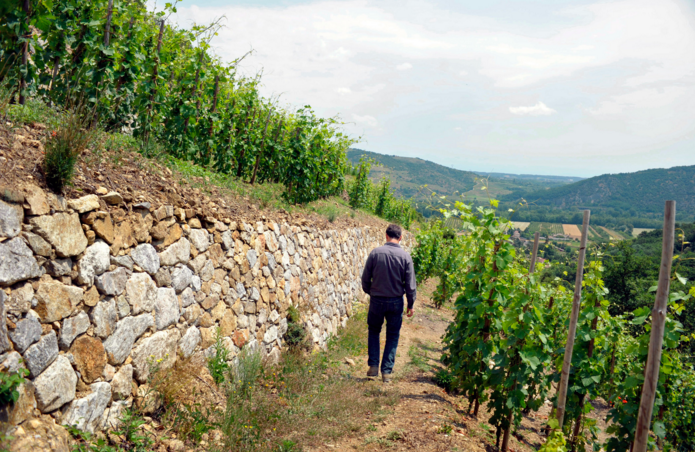
Jean-Louis Chave in St. Joseph
Jean-Louis Chave is one of the most cerebral and hard-working winemakers we’ve ever met. After taking over his family’s domaine in 1993, he soon began the demanding work of reclaiming abandoned hillside vineyards in Saint-Joseph, restoring terraces and replanting historic parcels. He launched Jean-Louis Chave Sélections in 1995, initially produced from fruit sourced from trusted growers in the historic heart of Saint-Joseph. As replanted family vineyards came into production, the wines increasingly drew on estate fruit, and the range gradually expanded.
With time, Jean-Louis was able to introduce additional cuvées: a Crozes-Hermitage sourced in part from young estate vines planted in 2003 on granitic hillside sites; a Saint-Joseph Blanc from vineyards acquired beginning in 2009, planted on granite and offering a more mineral, structured expression of the appellation; Hermitage Rouge and Blanc made from carefully selected parcels reflecting the character of the hill; and a Côtes du Rhône blended from high-quality vineyards in the southern Rhône, emphasizing freshness and balance.
Today, Jean-Louis and Erin Chave devote as much care to the Sélections wines as to those of the domaine, driven by a belief in the importance of championing the full range of Rhône appellations and expressing each with the same precision, authenticity and respect for terroir.
-
Jean-Louis founded JL Chave Sélections in 1995, initially working with fruit from trusted growers while he replanted and restored family vineyards, particularly in Saint-Joseph. As these vineyards came back into production, the project evolved and today many wines—most notably Hermitage and Saint-Joseph Offerus—are sourced entirely from the Chave family’s own vines, making the term “négociant” increasingly less accurate.
The range now includes Saint-Joseph, Crozes-Hermitage, Côtes-du-Rhône, and Hermitage, all made with the same parcel-by-parcel approach, native fermentations and restrained élevage that define the domaine wines. Wines such as Crozes-Hermitage Silène, sourced from the granitic hillside vineyards of Gervans and Larnage, show the finesse and energy of these historic sites.
The result is a collection of wines that consistently deliver exceptional value while offering a clear expression of the Chave style and philosophy.
-
Across both estate and partner vineyards, Jean-Louis Chave follows a philosophy of traditional, sustainable viticulture focused on preserving soil health and expressing terroir. Grapes are harvested by hand to ensure careful selection and gentle handling, and vineyards are managed for naturally low yields to enhance concentration, balance, and complexity. Farming practices emphasize minimal intervention, avoiding herbicides and artificial fertilizers in order to protect biodiversity, maintain living soils, and support the long-term health of the vineyards.
-
Vinification is guided by a commitment to preserving the purity of fruit and the character of each terroir. Parcels are vinified separately to allow for precise blending decisions that enhance balance and complexity. Fermentations are conducted primarily in stainless steel to maintain freshness and aromatic clarity, and the wines are aged in a combination of older oak foudres and barrels, with limited use of new oak so that élevage supports, rather than dominates, the wine’s natural expression.
Wines
Saint-Joseph Blanc “Circa”
Made from old-vine Roussanne grown on the granitic slopes of Mauves, Circa is the only white in the range sourced entirely from granite, giving freshness, minerality and structure in contrast to the softer profile of Hermitage Blanc. First produced in 2009, the wine takes its name from Circa, a mythological goddess, and reflects Chave’s growing focus on granite-grown white varieties in Saint-Joseph.
Crozes-Hermitage Blanc “Sybele”
A blend of Marsanne and Roussanne grown in Larnage, where distinctive kaolin-rich soils derived from decomposed granite give notable minerality and freshness. Fermented with indigenous yeasts and aged in used oak for 15–18 months, the wine is named Sybele, referencing both the phrase si belle (“so beautiful”) and the mythological goddess Cybele.
Hermitage Blanc “Blanche”
Named for Blanche of Castile, the queen who permitted the first vines to be planted on the hill of Hermitage, this wine is predominantly Marsanne with Roussanne from parcels including Péléat, Maison Blanche, and L’Hermite. Old vines and varied soils—from sandy pebbles to clay and loess—bring finesse, aromatics, and balance. Fermented in barriques and aged 18–24 months, it is built for depth and long aging.
Côtes-du-Rhône “Mon Coeur”
A blend primarily of Grenache and Syrah sourced from vineyards around Vinsobres, Rasteau, and Cairanne, with vines up to 60 years old. Fermented parcel by parcel and aged in large casks, the wine combines purity, freshness, and approachability. The name Mon Coeur (“my heart”) reflects Jean-Louis Chave’s personal attachment to these Rhône terroirs.
Crozes-Hermitage “Silène”
Named after Silène, the companion of Bacchus, this Syrah comes from hillside vineyards in Larnage and Gervans, including granite parcels rare for the appellation that give aromatic lift and finesse. Partly sourced from young estate vines planted in the early 2000s, the wine is aged 15–18 months in large oak casks and offers a refined, nervy expression of Crozes-Hermitage.
Saint-Joseph “Offerus”
Offerus was the first wine of the Sélections project, launched in 1995. The name refers to Saint Christopher before baptism. Sourced primarily from estate vineyards in the historic southern communes of Saint-Joseph and from younger vines not yet destined for the domaine bottlings, it is fermented in a mix of vessels and aged in older oak to preserve freshness, fruit and granite-driven character.
Hermitage “Farconnet”
Named for the Farconnet family, from whom the Chave family acquired part of the famed Bessards holdings, this Hermitage is sourced from parcels including Diognières, Péléat, and Greffieux. These sites contribute spice, finesse, structure, and flesh, creating a classic Hermitage profile. Fermented in tonneaux and stainless steel and aged 18–24 months in barrel, the wine offers depth and structure while remaining approachable earlier than the domaine bottling.