domaine Jean-Louis Chave
Mauves, Ardèche, Northern Rhône, France
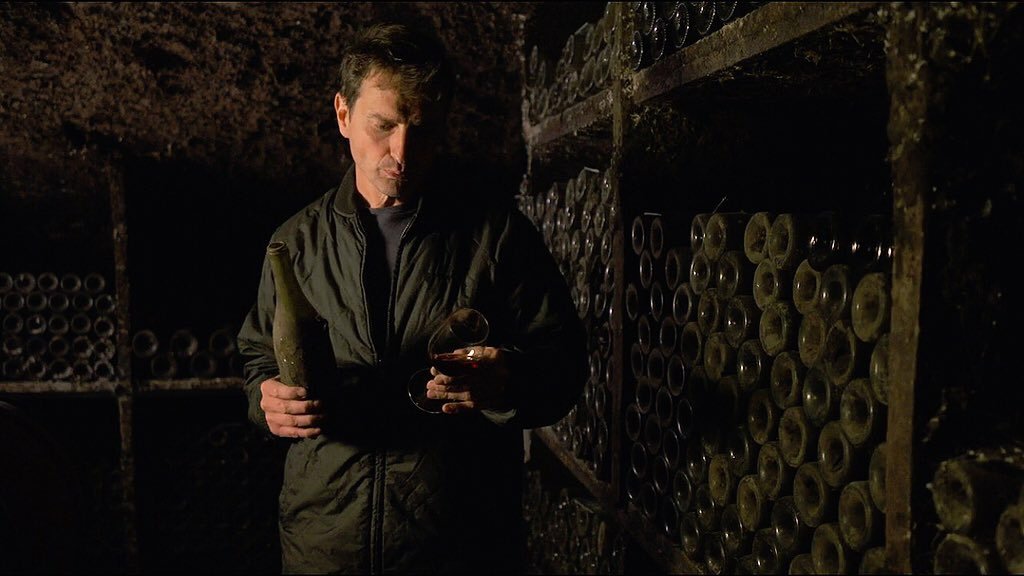
Jean-Louis Chave in his family cellar
The Chave family has been making wine in the Rhône Valley since 1481, and after 16 generations on the hill of Hermitage, the name has become synonymous with the appellation itself. This long stewardship has established Domaine Jean-Louis Chave as one of the Northern Rhône’s great benchmarks, guided by a philosophy in which the vineyard defines the wine, blending defines Hermitage, and the cellar’s role is to preserve what the land provides.
At the core of the domaine’s work is a meticulous parcel-by-parcel approach. Each vineyard is farmed, harvested and vinified separately, with extraction and élevage adapted to the conditions of the vintage rather than any fixed formula. Blending remains the essential step, bringing together the complementary qualities of Hermitage’s historic lieux-dits into a complete and harmonious whole.
Beyond Hermitage, Jean-Louis has spent decades restoring ancient terraces in Saint-Joseph, underscoring a deep commitment to preserving the region’s heritage. Today, alongside his wife Erin, he continues to guide the domaine as a reference point for classically made, terroir-driven wines of precision, longevity, and place, and as a longstanding partner and friend of Grand Cru Selections.
In 1995, Jean-Louis also founded JL Chave Sélections, originally a négociant project that has gradually evolved to rely largely on estate-grown fruit as replanted family vineyards came into production. The range now includes Saint-Joseph, Crozes-Hermitage, Côtes-du-Rhône and Hermitage, all crafted with the same respect for terroir and traditional methods that define the domaine.
-
Since 1481, the Chave family has cultivated vineyards in the Rhône Valley, with the domaine carefully passed down through 16 generations. During the phylloxera crisis in the 19th century, the family relocated to Mauves, where the cellars remain today, and began diversifying into fruit farming. In 1865, the family acquired their first parcels on the hill of Hermitage, laying the foundation for what would become one of the appellation’s most historic estates.
Today the domaine is led by Jean-Louis Chave, who took over from his father Gérard in 1992, continuing the family tradition of blending the diverse terroirs of Hermitage to produce wines of harmony, nuance, and longevity.
The estate now farms approximately 9.3 hectares of Syrah and 4.3 hectares of Marsanne and Roussanne across several parcels on the hill. In recent decades, Jean-Louis has also devoted significant effort to the restoration of abandoned terraces and historic vineyards in Saint-Joseph, reinforcing the domaine’s role as a reference point for traditional Northern Rhône winemaking and one of the great interpreters of Hermitage terroir.
-
The uniqueness of Domaine Jean-Louis Chave lies in its mosaic of vineyards rather than a single site, with each parcel contributing a distinct element to the final wines.
Hermitage Rouge
Chave’s Hermitage is built from a blend of historic lieux-dits, assembled to express the harmony of the hill as a whole.Bessards, a steep granite slope, forms the consistent backbone of the red, bringing structure, minerality, and longevity. Méal contributes richness, fruit, and flesh from its alluvial soils, while L’Hermite, with granite and loess, adds aromatic lift and freshness. Other parcels—including Péléat, Beaumes, Greffieux, and Rocoules—provide additional finesse, balance, and tannic structure.
Hermitage Blanc
The base is typically Marsanne from the nearly century-old monopole of Péléat, complemented by parcels such as Rocoules, L’Hermite, and Maison Blanche, with about 20% Roussanne bringing aromatic complexity. Though the precise proportions vary each year, the guiding principle remains constant: Hermitage is defined by the harmony of terroirs, not a single vineyard.
Saint-Joseph
In Saint-Joseph, the domaine farms parcels in the historic villages of Mauves, Tournon, Saint-Jean-de-Muzols and Lemps, many of them ancient terraces restored over the past decades. These sites, planted largely on granite soils, reflect the estate’s commitment to preserving historic vineyards and expressing the classical character of the appellation. -
Vineyard work is considered the foundation of the wine’s quality at the domaine. Farming follows principles often described as biodynamic—guided by observation, natural cycles and minimal intervention—though, as Jean-Louis Chave has noted, this approach reflects the way the family has always worked rather than adherence to a formal doctrine.
All vineyard work is carried out by hand or by horse, particularly on the steep slopes of Hermitage, to preserve soil structure and microbial life.
A strong emphasis is placed on the preservation and restoration of historic vineyards and terraces, both in Hermitage and Saint-Joseph, where Jean-Louis has spent decades reclaiming abandoned hillside parcels such as Bachasson and Clos Florentin. The domaine farms vines ranging in age from about 15 to over 90 years, and yields are intentionally kept low—around 35 hectoliters per hectare—to ensure concentration, balance, and a faithful expression of each terroir. Throughout the vineyards, decisions are guided by close observation rather than rigid formulas, reflecting a generational philosophy rooted in tradition, continuity, and respect for the land.
-
Vinification is guided by restraint and precision, with the aim of allowing each terroir and vintage to express itself naturally. Fermentations are carried out with indigenous yeasts, and each parcel is vinified separately to preserve its identity prior to blending, which remains the most essential step in defining Hermitage.
For the red wines, grapes are largely destemmed to maintain vineyard character, and fermentations take place in a combination of stainless steel, wooden vats, and tonneaux, with gentle extraction and manual punch-downs to favor finesse and balance over power.
For the white wines, fermentations occur primarily in oak barrels, followed by extended aging on lees to build texture and complexity.
Across the range, aging is long and conducted mainly in neutral oak and large-format vessels, with very limited use of new wood so as never to mask the terroir. Final blends are assembled after extensive tasting, and the wines are often bottled without filtration, emphasizing structure, harmony, and the capacity to evolve gracefully over decades.
Jean-Louis often emphasizes, the role of the cellar is not to impose a style, but to guide and preserve what the vineyard gives.
Wines
Hermitage Rouge
Defined by the art of blending, bringing together fruit from several historic parcels across the hill—including Bessards, Beaumes, L’Hermite, Péléat, Méal, Greffieux, and Diognières—each contributing structure, aromatics, richness, or finesse to create a wine greater than the sum of its parts. Bessards, a steep granite slope, consistently forms the backbone of the blend, while other sites add depth, texture, and balance. To preserve the character of each terroir, parcels are vinified separately, with fermentations in stainless steel, wooden vats, and tonneaux, gentle extraction, and largely destemmed fruit. After about 18 months of élevage, the components are blended and aged further in mostly neutral oak for a total of roughly 30 months, before bottling without filtration. The result is a wine of remarkable complexity, structure, and longevity, expressing the full diversity of Hermitage.
Hermitage Blanc
Composed predominantly of Marsanne (about 80–85%) with Roussanne (15–20%), the blend drawn from several historic parcels on the Hermitage hill—Rocoules, Péléat, L’Hermite, and Maison Blanche—each contributing a distinct element of structure, aromatics, and balance. Rocoules provides much of the backbone and aging potential, while Péléat adds finesse and complexity, L’Hermite contributes aromatic lift and precision, and Maison Blanche brings texture and freshness. Fermentation takes place primarily in neutral oak barrels, followed by approximately two years of aging in oak to integrate the wine while preserving mineral character and purity of fruit. Produced in limited quantities, Hermitage Blanc is built for longevity, combining richness, structure, and remarkable aging potential.
Saint-Joseph
Drawn from a mosaic of historic parcels in the original villages of Tournon, Mauves, Saint-Jean-de-Muzols, and Lemps, each parcel contributes a distinct element to the blend. Old vines in Tournon, some dating to the early 1900s, grow on granite mixed with clay and bring depth and supple tannins; the more acidic granite slopes of Mauves provide freshness and structure; Pichonnier in Saint-Jean-de-Muzols, with finer-grained granite, contributes generosity and ripe tannins; and Bachasson in Lemps adds structure from soils comparable to parts of Hermitage. Fermentation is carried out with indigenous yeasts in a combination of wood tonneaux and stainless steel tanks, followed by 15–18 months of aging in barriques, a measured élevage designed to preserve the character of each terroir while building structure, complexity, and aging potential.
Saint-Joseph “Clos Florentin”
Sourced from a historic walled vineyard near Mauves, one of the most prestigious zones of Saint-Joseph, Clos Florentin was acquired by Jean-Louis Chave in 2009 and first bottled separately in 2015, having previously been blended into the estate’s Saint-Joseph. Long owned by a family of homeopathic doctors and traditionally farmed with natural treatments, the vineyard is planted to old Syrah vines, some over eighty years of age, in decomposed granite soils that naturally limit yields and enhance concentration. The clos benefits from a protected microclimate and consistent ripening, and is farmed with a philosophy of minimal intervention. Fermented in stainless steel and tonneau with gentle extraction and aged just over a year in neutral oak, the wine is typically denser and more structured.
Hermitage Rouge “Cuvée Cathelin”
Produced only in exceptional vintages, Cuvée Cathelin is one of the rarest and most sought-after wines of the Rhône Valley. First created in 1990 and named in honor of the painter Bernard Cathelin, a close friend of the family - the label itself reproduces one of his works. The wine is made entirely from Syrah selected from the finest parcels of Hermitage, often with a significant proportion from Les Bessards. Vinified parcel by parcel and aged with a higher proportion of new French oak and extended maturation, it is crafted to achieve greater concentration, structure and longevity than the classic Hermitage. Produced only a handful of times and in extremely small quantities—Cuvée Cathelin is prized for its depth, power and ability to age for decades.