
Guillaume Lafon
Côte de Beaune, France
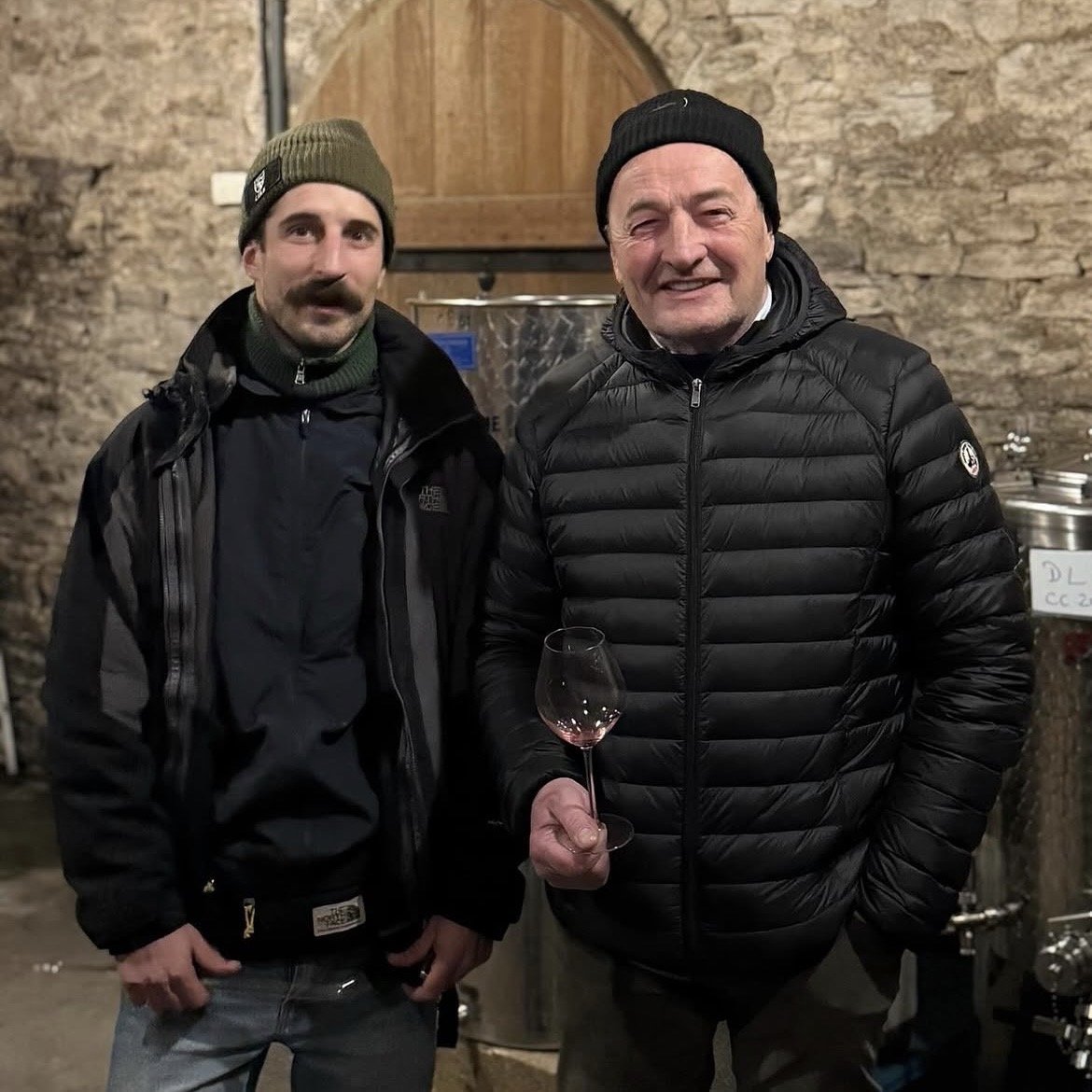
Guillaume & Dominique Lafon
Guillaume Lafon represents one of Burgundy's most compelling generational transitions: a domaine rooted in one of the Côte de Beaune's great winemaking legacies while remaining firmly focused on the future.
Established by Dominique Lafon in 2008 as an independent project outside Domaine des Comtes Lafon, the estate was conceived as a place for continual learning, experimentation, and the transparent expression of terroir. Since 2015, the wines have been vinified, aged, and bottled at Château de Bligny-lès-Beaune, a collaborative winery inspired by the custom-crush model Dominique encountered while consulting in California and Oregon—an environment that reflects the domaine's spirit of curiosity, collaboration, and innovation.
The project entered an exciting new chapter in 2023 with the arrival of Guillaume Lafon. Unlike many fifth-generation Burgundian vignerons, Guillaume took an unconventional route back to the family domaine. After studying philosophy and science, he spent several years working in educational technology and software development before realizing he wanted to create something tangible. "Working behind a computer made me want to work with soil," he recalls. Formal studies in viticulture and oenology at the CFPPA in Beaune, together with practical experience at Marquis d'Angerville, harvests alongside his father and time at Lingua Franca in Oregon, ultimately led him back to Burgundy. With the release of the 2024 vintage, the wines officially appear under the Guillaume Lafon label, marking a seamless transition from father to son.
While remaining deeply rooted in Dominique's philosophy of purity, precision and transparent terroir expression, Guillaume brings a thoughtful vision for the future—one centered on sustainable farming, continual improvement and preparing Burgundy's vineyards for a changing climate through a careful balance of tradition and innovation. Guided by the belief that every vintage offers another opportunity to learn, his goal is not to reinvent the domaine, but to thoughtfully evolve it while preserving its deliberately human scale.
For us, Guillaume Lafon represents not only the continuation of an extraordinary legacy, but one of Burgundy's most exciting domaines to watch in the years ahead.
-
The domaine’s holdings are concentrated in some of the Côte de Beaune’s most distinctive hillside sites. For whites, the core estate parcels include Bourgogne Blanc from Les Femelottes in Puligny-Montrachet and Les Grandes Coutures in Meursault, Meursault Narvaux from high on the slope above Genevrières, and Puligny-Montrachet 1er Cru Champ Gain, a high-altitude premier cru known for density and precision.
Red wine production centers on Volnay, Volnay 1er Cru Les Lurets, and Beaune 1er Cru Épenottes. Les Lurets is especially interesting because the same hillside includes both village-level and premier cru sections, allowing Guillaume to produce two expressions of the same historic slope.
Dominique has long been particularly enthusiastic about Beaune, seeing it as one of the Côte de Beaune’s most undervalued sources of quality and value. In the podcast, he describes the domaine as freer and more relaxed than Comtes Lafon—a place where different sites, shorter élevage, and a more experimental spirit can reveal another side of Burgundy.
-
Gevrey-Chambertin sits at the heart of the Côte de Nuits and illustrates the classic geology of the Côte d’Or. The village is defined by faulted Jurassic limestones, beds of marl, and marked shifts in elevation created by the Combe Lavaux. These variations produce highly differentiated sites within just a few meters of one another.
The northern sector — including Premier Crus such as Combe aux Moines, Goulots, and Champeaux — is particularly prized. Here, crinoidal limestone and sandy marl dominate, with pockets of fossil-rich ostrea acuminata marl also found in grands crus like Clos de Bèze and Bonnes Mares. The cool air descending from the combe adds a climatic influence, helping to preserve freshness and structure.
Together, these geological and climatic factors give Gevrey-Chambertin its signature power, depth, and mineral precision.
-
The vineyards are farmed according to organic and biodynamic principles, continuing the philosophy Dominique adopted early in his career. Guillaume frames his approach around three guiding principles: sustainability, autonomy and continuous improvement.
Rather than approaching farming dogmatically, Guillaume is focused on adaptation. He is interested in preserving the domaine’s human scale while preparing the vineyards for Burgundy’s changing climate. This includes traditional practices such as horse plowing, but also experimentation with higher trellising, alternative cultivation methods, electric crawler tractors, and drone-assisted vineyard treatments. The objective is not innovation for its own sake, but more precise, responsible farming that allows each site to speak clearly.
-
The cellar philosophy is centered on purity, precision and transparent terroir expression. Dominique emphasizes the goal is not to taste the winemaking: not the oak, not the bâtonnage, not the lees, but the vineyard. In his words, great cellar work is not about doing nothing; it is about being precise, clean, attentive and discreet.
Whites are generally whole-cluster pressed, settled, fermented with indigenous yeasts, and raised in barrel or large-format oak before a period in tank. Little to no bâtonnage is used in order to preserve freshness, tension, and site transparency.
Reds are typically fully destemmed, macerated gently for 15–20 days, and raised in barrel before resting in tank prior to bottling. Extraction is deliberately restrained, often with very few punch-downs, allowing finesse and aromatic clarity to take precedence over power.
Wines
Bourgogne Aligoté
Sourced from organically farmed, century-old vines near Bouze-lès-Beaune, this Aligoté reflects Guillaume's spirit of experimentation. The grapes are gently pressed before fermenting and aging for 16 months entirely in stainless steel under nitrogen protection, with minimal sulfur additions. Conceived as a step toward future sans soufre winemaking, the wine is vibrant, saline, and remarkably pure, emphasizing freshness and the naturally energetic character of old-vine Aligoté.
Bourgogne Blanc
Produced from two exceptional parcels—Les Grandes Coutures in Meursault and Les Femelottes in Puligny-Montrachet—this Bourgogne Blanc consistently punches well above its appellation. Whole-cluster pressed and fermented with indigenous yeasts, the wine spends approximately twelve months in barrel without new oak before a short period in tank prior to bottling. Little to no bâtonnage preserves freshness and precision, resulting in a Chardonnay that marries the generosity of Meursault with the lifted mineral character of Puligny.
Pernand-Vergelesses
Purchased from the high-altitude parcel of Le Devant des Cloux, this southeast-facing vineyard produces one of the latest-ripening Chardonnays in the portfolio. Following whole-cluster pressing and light settling, the wine ferments with native yeasts in barrel before aging for twelve months in oak and an additional six months in stainless steel on its fine lees. The resulting wine combines cool-climate tension, citrus-driven freshness, and remarkable depth, highlighting the increasingly important role of elevated vineyard sites in a warming Burgundy.
Meursault "Narvaux"
High above Genevrières, the twin parcels of Narvaux Dessus and Narvaux Dessous consistently produce one of the domaine's most distinctive wines. Dominique often describes Narvaux as a "vintage translator," faithfully expressing each growing season while maintaining the generosity expected of Meursault. Whole-cluster pressed and fermented with indigenous yeasts, the wine is aged for approximately eighteen months in barrel, with about one-third new oak and minimal bâtonnage.
Puligny-Montrachet 1er Cru Champ Gain
Situated high on the slope northwest of the village, Champ Gain is among Puligny's coolest premier crus, producing wines of exceptional precision and longevity. The fifty-year-old vines are whole-cluster pressed before fermentation and élevage in barrel, with roughly 25% new oak over eighteen months.
Corton-Charlemagne Grand Cru
Produced from purchased fruit grown on the upper slopes of Corton above Ladoix-Serrigny, this Grand Cru expresses the tension and mineral power that define the appellation. Traditional barrel fermentation and élevage emphasize structure and longevity while preserving the vineyard's remarkable purity.
Volnay
Sourced from the village section of Les Lurets, directly below Caillerets, this wine captures Volnay's signature elegance. Fully destemmed and gently macerated for 15–20 days, it spends twelve months in barrel followed by six months in tank before bottling. Dominique favors restrained extraction, allowing bright red fruit, floral aromatics, and silky tannins to define a Pinot Noir of finesse rather than power.
Volnay 1er Cru Les Lurets
Produced from the premier cru portion of the same hillside, Les Lurets offers greater structure and complexity while preserving Volnay's hallmark grace. Gentle extraction during fermentation and extended élevage allow the vineyard's fine tannins and vibrant acidity to frame layered red fruit, spice, and exceptional aging potential.
Beaune 1er Cru Épenottes
Bordering Pommard Les Épenots, this long-term leased parcel has been farmed directly by Dominique since 2010. The grapes are fully destemmed before a gentle 15–20 day maceration, receiving only three punch-downs throughout fermentation before eighteen months of barrel aging.
Beaune 1er Cru Grèves
Drawn from three complementary parcels across the celebrated slope of Grèves, this cuvée showcases what Dominique considers Beaune's finest premier cru. Vinified with complete destemming, very gentle extraction, and eighteen months in barrel, the wine combines the generosity of the lower slope with the tension and freshness of the upper vineyard, producing a Pinot Noir of impressive depth and length.
Beaune 1er Cru Vignes Franches
Located on the upper slope just north of Clos des Mouches, Vignes Franches consistently delivers the most structured red in the portfolio. Fully destemmed and fermented with minimal extraction before eighteen months of élevage, the wine offers darker fruit, firm yet polished tannins, and the concentration to reward extended cellaring while maintaining the domaine's characteristic emphasis on finesse and transparency.