
Domaine Camille Thiriet
Corgoloin, Côte de Nuits, France
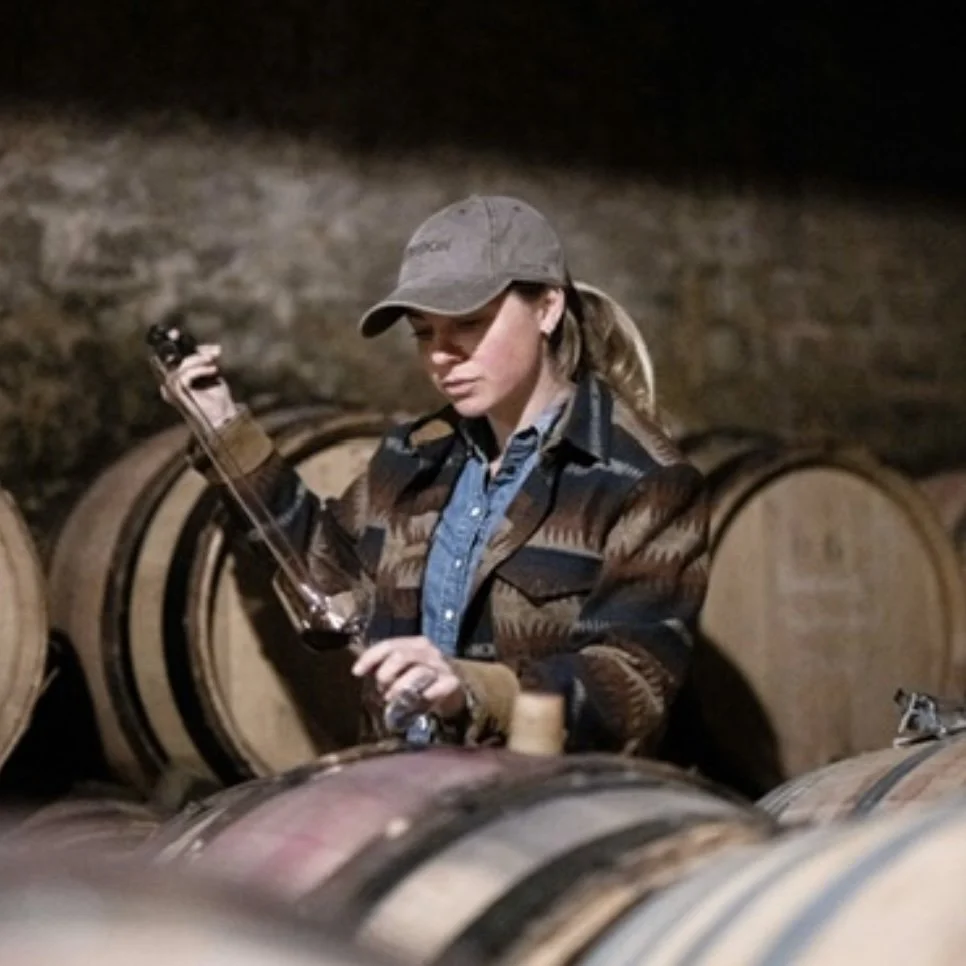
Camille Thiriet
Photo courtesy of Nicolas Spanier
We were immediately charmed by Camille Thiriet’s drive to produce artisanal Burgundies, full of personality, from a tiny garage behind her parents’ bed and breakfast in the Côte de Nuits village of Comblanchien. From their very first vintage in 2016—just 2,000 bottles—Camille and her husband, Matt Chittick, embraced the role of modern garagistes, crafting small-lot cuvées by hand (and foot), often late into the night, bottling, labeling and waxing each bottle themselves. It was, and remains, a true labor of love—and a journey Grand Cru has followed since that very first vintage.
When the opportunity arose in 2022 to acquire a 4.5-hectare domaine in nearby Corgoloin, they fully committed, transforming their micro-négoce project into a growing estate. Today, farming nearly 6 hectares, they bring renewed attention to the long-overlooked terroirs of Corgoloin, Comblanchien, and Prémeaux in the southern Côte de Nuits, revealing their nuance and potential through precise, site-driven wines while elevating the Côte de Nuits Villages appellation.
Camille, who did not come from a winemaking family, credits the support of mentors such as Didier Fornerol and Bernard Noblet as instrumental to her development. Her approach is intuitive rather than prescriptive—guided by observation, feeling and a desire to create balance between terroir, farming and winemaking. This is a Burgundy story grounded in tradition yet unmistakably modern—driven by intuition, hard work and a deep respect for terroir. And they are only just getting started.
-
Domaine Camille Thiriet began in 2016 as a micro-négoce project, founded by Camille Thiriet and Matt Chittick. Their first wines were made without electricity in a modest 20-square-meter garage behind Château de Comblanchien—an intentionally humble beginning that continues to define their hands-on, artisanal approach.
Raised in Paris, Camille developed an early sensory awareness through her passion for horses and an interest in perfumery—an instinct that would later shape her approach to wine. After literary studies, she trained in Beaune and Bordeaux, but quickly moved away from academic theory in favor of hands-on experience in the vineyards and cellar.
After years of experience across both production and sales, Camille and Matt set out to realize a long-term goal: to produce Burgundy under their own label. The two met while working for Nicolas Potel at Domaine de Bellene—Matt as winemaker (2011–2014) and Camille leading sales. Through their work at Maison Roche de Bellene, which spans over 75 appellations, they developed a deep understanding of Burgundy’s terroirs and built a strong network of trusted growers. These relationships remain central today, allowing them to source exceptional fruit from producers they know and respect.
-
Based in the southern Côte de Nuits, Camille Thiriet works with parcels in Corgoloin and Comblanchien—two villages that form a transitional, highly geological sector of the appellation. The hillsides here are carved into hard Bathonian limestone, with generally gentle slopes that reveal a clear progression of soils: lighter brown soils with limited limestone at the top, increasingly rocky sections mid-slope, and deeper clay-limestone soils at the base.
Camille’s holdings in Corgoloin illustrate this diversity particularly well, spanning three distinct terroirs along the same slope, each defined by variations in soil composition and elevation. This combination of extremely hard limestone and clay pockets provides both tension and depth.
Together, these sites offer a broad palette of micro-terroirs, enabling both precise single-parcel wines and carefully constructed blends. The resulting wines are structured yet approachable, with a strong sense of place and clear expression of their origins.
-
Since taking over the domaine in 2022, they have begun a gradual transition from lutte raisonnée toward more organic farming practices, focusing above all on restoring life to the soils. Work in the vineyard is thoughtful and measured, combining horse plowing and tractor work to limit compaction and encourage healthy, living soils.
Their approach is rooted in close observation and adaptability throughout the growing season, with the belief that long-term balance comes from attentive vineyard work rather than rigid systems. They avoid strict labels such as “organic” or “natural,” favoring a pragmatic philosophy guided by bon sens (common sense). Interventions are kept to a minimum and only when necessary, particularly in challenging vintages where excessive treatments can be detrimental to soil health.
In the cellar, the same mindset applies: the focus remains on the vineyard, with minimal intervention and sulfites added only at bottling. The wines are inspired by traditional expressions of the Côte de Nuits, without dogma in either farming or winemaking.
-
In the cellar, the focus is on minimal intervention and a deep trust in the fruit. Fermentations are natural, using native yeasts, with gentle handling throughout. Pump-overs are carried out by gravity, and the grapes are pressed in a small wooden basket press. Extraction favors infusion over force, with long, cool macerations lasting approximately 13–17 days, and a meaningful proportion of whole clusters depending on the vintage. Foot treading is used where appropriate, further emphasizing a hands-on approach.
Oak is used with restraint to preserve the clarity of fruit and terroir. For the whites, fermentation begins in stainless steel—a shift from earlier vintages when it was done entirely in barrel—before the wines are transferred to barrel to complete fermentation and undergo malolactic conversion. They are then aged for around 10 months in a mix of vessels, and finally returned to stainless steel prior to bottling to retain freshness. Sulfur is used sparingly, typically only at bottling.
The result is a style that privileges precision, texture, and site expression over technique.
Wines
Aligote du Jardin
A blend of three parcels of Aligoté Doré from Pommard, Meursault (Les Basses Gouttes, with vines over 100 years old) and Le Jardin in Corgoloin. The Pommard portion sees a short skin contact before blending. Aged in used barrels for one year.
Bourgogne Chardonnay Cuvée Confidentielle
Produced in partnership with a dedicated grower in Mâcon-Cruzille. Focused on early ripeness and high natural acidity, resulting in a Chardonnay that balances ripeness with freshness and precision.
Côtes du Jura Blanc
Camille’s connection to the Jura comes through her grandmother, which sparked her interest in working with fruit from the region, particularly around Arbois. Production is very limited—typically just one demi-muid per year.
Côte de Nuits Villages Blanc
Sourced from La Montagne in Corgoloin, just across the road from the domaine’s red parcel, this young-vine Chardonnay grows on hard limestone with almost no topsoil. In 2024, the exceptionally low yields led Camille to combine fruit from La Montagne and La Toppe Citeaux in Comblanchien. The wine is therefore bottled simply as Côte de Nuits-Villages Blanc, rather than under the usual “La Montagne” lieu-dit.
Bourgogne Rouge En la Place
From 90-year-old vines between Comblanchien and Corgoloin. Small berries and 40% whole cluster fermentation contribute to a lifted, aromatic style.
Bourgogne Rouge Les Chagniots
Sourced from 60-year-old vines south of Clos des Langres. A deeper, more structured expression of Bourgogne Rouge, with 40% whole cluster fermentation.
Côte de Nuits-Villages Aux Montagnes
Just in front of her parents' house in Comblanchien, this 50-year-old parcel in Comblanchien is planted on clay-limestone soils with shallow topsoil. Fermented with 10–15% whole cluster and bottled unfiltered. Camille has made this cuvée since her first year.
Côte de Nuits Villages “La Robignotte”
A monopole parcel in Corgoloin on distinctive blue marl soils. Named after a former Napoleonic-era owner, with 40% whole cluster fermentation.
Cote de Nuits-Villages La Montagne
One of the new domaine vineyards, not to be confused with Aux Montagnes in Comblanchien. La Montagne is on the southern side of Corgoloin quite high on the slope - 280 m in altitude. The soil is sand over clay. Fermented with 50% whole clusters, offering a balanced expression of the site.
Cote de Nuits Village Clos Magny
A high-altitude (350m) parcel above La Montagne on the same slope with shallow, rocky soils. Fermented with 100% whole cluster, combining delicacy with intensity.
Côte de Nuits Villages “Cuvée Deslandes”
A blend of parcels in Comblanchien and Corgoloin, combining complementary terroirs. Fermented with around 50% whole clusters and long, gentle infusions, resulting in a vibrant and expressive style.