
Champagne Dhondt-Grellet
Flavigny, Côte des Blancs, Champagne, France
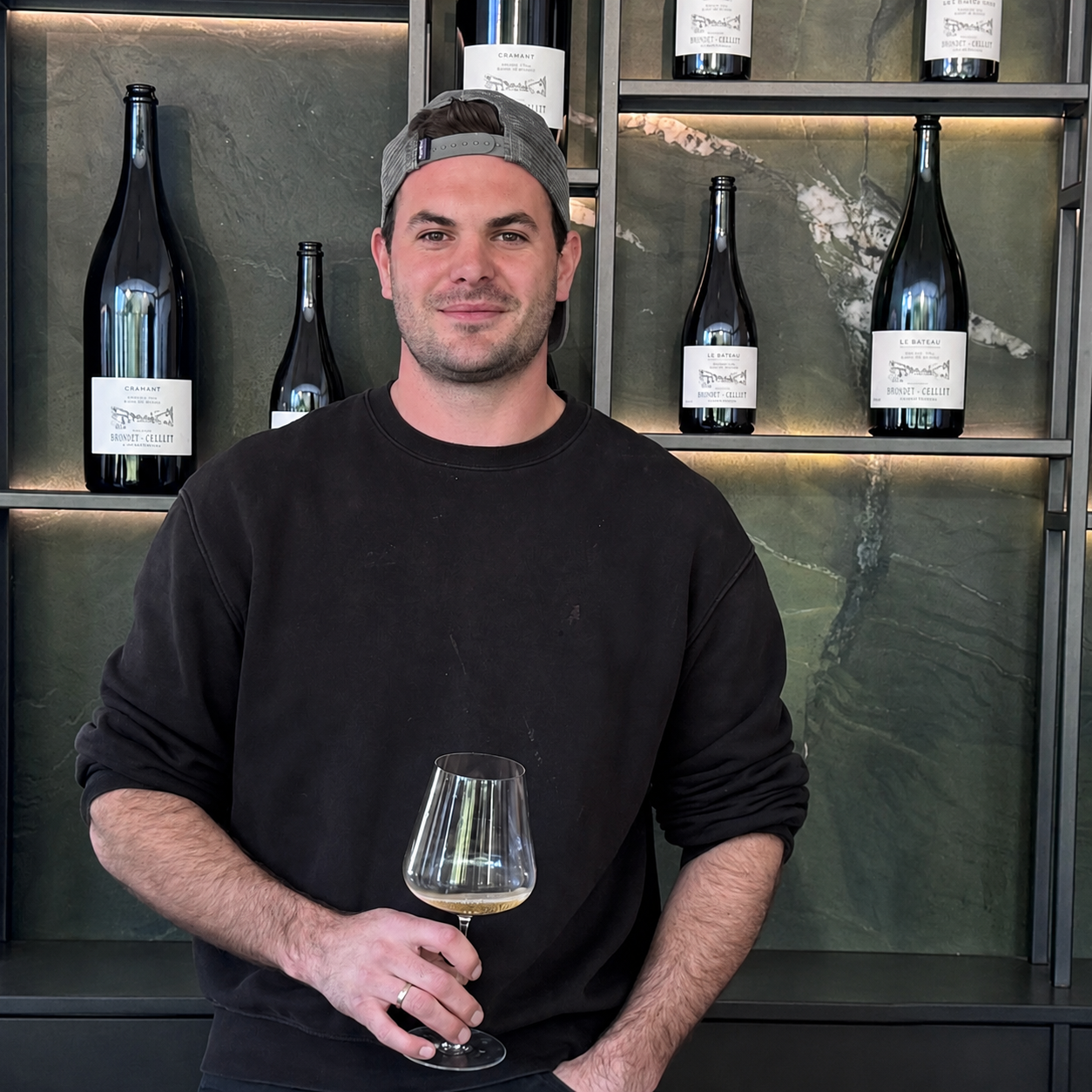
Adrien Dhondt
Grand Cru Selections has worked with Adrien Dhondt since his earliest vintages at the family estate, and it has been a privilege to follow the steady evolution of his work in the Côte des Blancs. Under his direction, Champagne Dhondt-Grellet has taken on a sharply defined identity, rooted in precision, site expression and a thoughtful approach to Chardonnay. Centered on key parcels in Cramant, Cuis and most recently the Coteaux du Sézannais, the wines are refined, mineral and quietly expressive—articulating the nuances of the region’s chalk soils with clarity and tension.
In 2018, Adrien began a small-scale négociant project under his own name, working with fruit from villages such as Avize, Oger and Le Mesnil-sur-Oger. Each cuvée is produced as a singular release, shaped by the vintage, with sites often changing from year to year. A consistent approach to vinification allows these cuvées to highlight individual villages or micro-terroirs with clarity. Bottled at slightly lower pressure to emphasize texture, they offer a distinct complement to the domaine.Driven by curiosity and a relentless pursuit of terroir expression,
Adrien continues to push the boundaries of what is possible in Champagne, and we couldn’t be more excited about the direction of this young domaine.
-
Champagne Dhondt-Grellet was established in 1986 in the village of Flavigny, just outside Avize, when Éric Dhondt and Édith Grellet chose to begin estate bottling their own wines. The Dhondt family, originally Belgian farmers, had acquired vineyards in the Sézannais in the 1960s, while the Grellet family is rooted in Cuis and Cramant. Starting with just two hectares, the domaine has since expanded to roughly three times its original size.
A new chapter began in 2012, when Adrien took over winemaking at the age of 22. Today, he works alongside his sister Alice in continuing to shape the domaine’s direction, refining its focus on Chardonnay grown across the Côte des Blancs.
Since the beginning, the family has maintained a perpetual reserve, forming a quiet but essential part of the domaine’s identity. Each year, a portion is drawn off for tirage and replenished with wine from the new vintage before being returned to barrel on its lees. The reserve is moved back to tank ahead of harvest, and the cycle repeats—ensuring continuity while keeping the barrels in constant use.
Recent vintages mark an important step in the domaine’s evolution. The 2021 harvest, in particular, forms the backbone of several key cuvées, often supported by reserve wines to balance the vintage’s natural tension. Wines such as Roc Solaire reflect a shift toward more structured, textural expressions, where élevage and fruit maturity play an increasingly central role alongside freshness.
-
Adrien Dhondt farms Chardonnay across a focused range of sites in the Côte des Blancs, with holdings centered in Cramant (Grand Cru) and Cuis (Premier Cru), complemented by parcels in Chouilly and the Coteaux du Sézannais. While the domaine continues to expand, these core villages define its identity.
In Cramant, vineyards trace the slopes of the Butte de Saran, a chalk outcrop that forms a natural amphitheater with predominantly east and south-facing exposures. Here, thin topsoils over chalk bedrock, often mixed with clay, produce wines of precision, salinity, and pronounced mineral tension. Key parcels include Le Bateau, a south-facing site with excellent drainage and old vines planted in 1951; Les Longues Verges, on a western slope with slightly greater clay content and water retention; and La Garenne, where deeper, clay-rich soils lend broader texture while maintaining the village’s hallmark finesse.
Just to the north, Cuis shares the same chalk foundation but with deeper topsoils, resulting in wines that are slightly more generous while retaining freshness and mineral clarity. Adrien farms a range of old-vine parcels here, notably Les Nogers, a gently sloping site that balances tension and water availability, producing wines that reflect the broader, more open character of the cru.
In Chouilly, at the northern limit of the Côte des Blancs, variations in chalk depth and soil composition give rise to a range of expressions. Adrien’s principal parcel, Les Longues Verges, lies on the Butte de Saran at the border with Cramant. With a western exposure and chalk soils containing more clay, it produces wines of notable depth and structure, further intensified by low yields from court-noué (fanleaf virus).
The domaine’s holdings in the Coteaux du Sézannais, rooted in family vineyards dating back to Adrien’s grandfather, bring a complementary dimension. Here, clay, limestone, and silex soils, combined with south-facing exposures, yield wines of greater density and a more solar profile, rounding out the range of expressions across the estate.
-
Adrien Dhondt farms according to a non-certified organic and biodynamic philosophy, which he describes as “peasant viticulture,” focused on cultivating living soils and minimizing intervention. He avoids all synthetic products, relying instead on significant soil work—including horse plowing since 2021—homemade compost, and careful manual practices such as short pruning and severe debudding to control yields and achieve optimal ripeness. His approach is highly parcel-driven, with decisions made site by site. Over the past decade, his farming has evolved from a more traditional Champagne approach toward a more precise, micro-parcel focus influenced by the new generation of growers, emphasizing sustainable practices and a balance between freshness, concentration, and clear terroir expression.
-
In the cellar, Adrien Dhondt follows a low-intervention, parcel-driven approach, now centered almost entirely on barrel fermentation with indigenous yeasts. After a very short settling (around six hours), wines are transferred directly to barrel with minimal sulfur additions and undergo fermentation and élevage on their lees for approximately eight months prior to tirage, without fining, filtration or cold stabilization. During this period, decisions such as topping up or bâtonnage are made entirely by tasting, reinforcing his highly intuitive, lot-by-lot approach.
Adrien has moved toward predominantly barrel élevage since 2020, using Burgundian barrels (Damy and François Frères), reflecting a clear stylistic influence from Burgundy. Total sulfur levels remain low (around 40 mg/L), and the wines emphasize texture, vinosity, and site expression.
Both malolactic fermentation and aging are adapted by parcel and vintage, with no fixed formula: some wines undergo full malo for roundness, while others are partially or fully blocked to preserve tension. Similarly, aging on lees typically ranges from 24 to 48 months, with certain cuvées extended to 36–60 months or longer.
The overall objective is balance—between freshness and texture, precision and depth—with each wine shaped by the conditions of the vintage rather than a prescribed style.
Wines
Champagne Dhondt-Grellet
Roc Solaire
Roc Solaire marks a new direction for the domaine, sourced entirely from the Coteaux du Sézannais, including parcels originally planted by Adrien's grandfather in the 1960s and 1970s. This terroir—an extension of the Côte des Blancs with distinctive clay and silex soils—yields broader, earlier-ripening wines. Composed primarily of Chardonnay (with a small portion of Pinot Noir) and blended with a perpetual reserve dating back to 1986, it is vinified in barrel with indigenous yeasts and full malolactic fermentation, resulting in a more solar, generous expression while retaining a saline backbone and mineral tension.
Les Terres Fines
Les Terres Fines is a 100% Chardonnay Blanc de Blancs sourced from a number of small parcels scattered around the village of Cuis and Chouilly. It is vinified in oak and is 70% of the base vintage with the remainder a perpetual reserve started in 1986. Dosage is under 1g/l. It’s his most fine-boned cuvée and serves as a snapshot of the northern Cote de Blancs.
Cramant
This cuvée is now produced exclusively from Grand Cru Chardonnay from Cramant, primarily from the lieu-dit La Garenne, a historic garden site with slightly sandier, clay-influenced soils that bring added breadth while preserving Cramant’s signature chalky finesse and salinity. Formerly blended with Chouilly fruit, Adrien has refined the wine to focus solely on Cramant for greater precision and terroir expression. Vinified and aged in oak with full malolactic fermentation and extended lees aging, it is an elegant, structured Champagne with layered texture and a saline finish.
Les Nogers - Cuis 1er Cru
Starting with the 2012 vintage, Adrien began bottling this wine under the name of its lieu-dit, Les Nogers, to highlight its distinct terroir identity. The parcel, planted to vines over 50 years old, sits on the same hillside as Le Bateau in Cramant but within the village of Cuis, with soils transitioning from sandy-clay at the base to increasingly chalky higher up the slope.
Le Bâteau - Cramant Grand Cru
Le Bateau is considered one of the best lieu-dits of Cramant and Adrien's vines planted there are the oldest of the estate. The vineyard was planted in 1951 by Adrien's great-grandfather and follows the contours of the slope, some 70% southern exposure, the rest to the north. Vinified entirely in oak with only with indigenous yeasts. It spends 8 months on lees in barrel. There is no filtration, fining, or cold stabilization. He leaves it to age in his cellar for 3-4 years and one additional year on cork after disgorgement. Dosage is less than 3g/L but in past vintages has been zero dosage.
Les Côtes au Vent – Cuis 1er Cru
This new single-parcel cuvée is crafted from old-vine Pinot Meunier (planted in 1954) in Cuis, on one of the northernmost slopes of the Côte des Blancs with a southeast-facing exposure. Planted on thin, silty-chalk soils, the site yields a remarkably precise and mineral expression of Meunier—an uncommon variety in this Chardonnay-dominated region. Vinified entirely in barrel with full malolactic fermentation and aged eight months on lees (no filtration), the 2021 debut reflects a challenging vintage, resulting in a wine defined by freshness, finesse, and clarity rather than power—an elegant and atypical Blanc de Noirs from the Côte des Blancs. Dosage: 2.5 g/L (Extra Brut)
La Brute – Chouilly Grand Cru
La Brute is sourced from old-vine Chardonnay planted in 1974 in Les Longues Verges, a Grand Cru parcel in Chouilly facing Cramant. This early-ripening site, marked by low yields due to fanleaf virus, produces deeply concentrated fruit while retaining the tension and freshness of its chalk soils. Vinified entirely in barrel with full malolactic fermentation, the wine reflects Adrien’s pursuit of concentration through meticulous vineyard work and low yields. Blending incorporates both the current vintage and a portion of perpetual reserve, contributing depth and complexity. The result is a distinctive, textural Champagne—rich yet precise, balancing power, reduction, and mineral tension. Dosage: 0 g/L (Extra Brut)
Adrien Dhondt
Plantes d’Oger – Grand Cru Blanc de Blancs (2020)
Sourced from old vines planted in 1950 in Oger Grand Cru, near Le Mesnil-sur-Oger, this mid-slope parcel is defined by exceptionally chalky soils that lend precision and tension. Vinified in barrel with full malolactic fermentation and aged 8 months on lees without fining or filtration, the wine is a pure, mineral-driven expression of Chardonnay. Dosage: 1 g/L (Extra Brut)